We don't write code anymore
Written by Vincent Quigley
Something has shifted in software engineering. Not in the abstract, future-of-work sense. In the daily mechanics of how code gets planned, produced, reviewed, shipped, and monitored.
I think we are now in the fourth generation of coding.
The deliberately uncomfortable version is that we no longer write code.
This is a field report on how my team works now.
I'm Vincent, an engineering manager at Sanity who still codes, and I have been using AI in engineering work for about 2.5 years. Nine months ago, I moved into AI-first workflows and wrote about that journey in "First attempt will be 95% garbage" when everything felt new and uncharted. This post is about what changed after AI-first workflows became the default.
Over the last few months, my team has become AI-first; we build, release, and monitor software with AI as the main working surface. I mean "we no longer write code" literally enough to be useful, but not so literal as to be silly. Code still gets produced. Pull requests still get reviewed. Systems still ship. What has changed is the job's center.
A few weeks ago, I asked the team how much code they still write by hand. This is a team of senior engineers, each with at least 10 years of experience. One person said 1%. Another said they had tried writing code directly, then found themselves going back to the agent because it no longer felt like the intuitive path. That can sound scary. I do not think it needs to be.
That changes what engineers need to be good at, how teams should organize around the work, and what engineering managers need to pay attention to. This post is about those changes. The new development pipeline, the uncomfortable failure modes, and why judgment matters more when implementation gets cheaper.
The four generations of coding
The frame I use is that software engineering has moved through four generations of abstraction. Each generation changed what engineers wrote, how they learned, and where the hardest problems in the job lay.
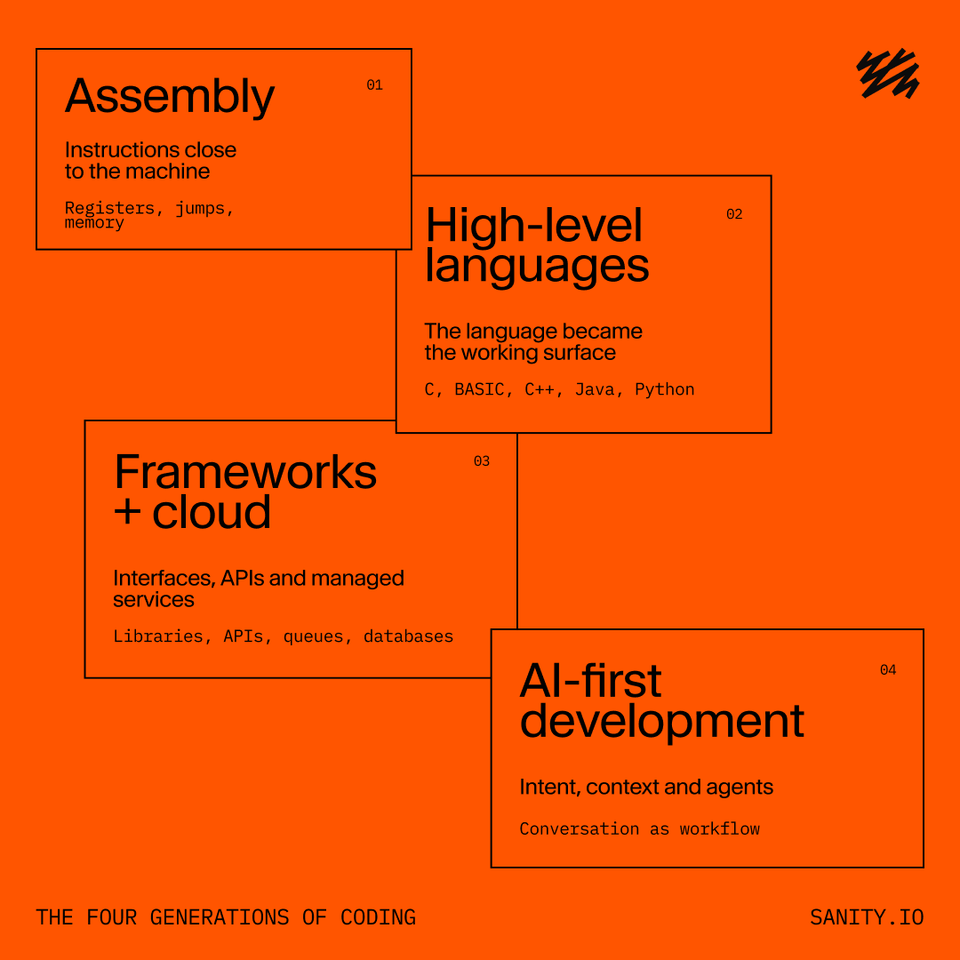
The first generation was assembly. Engineers wrote instructions close to the machine. The work was coding registers, jumps, memory addresses, and manuals open beside them. It involved direct control and precise knowledge of the hardware.
Internal server error