Content is context
Written by Magnus Hillestad
If an agent is answering your customers, you want to decide what it says. Until this fall, we couldn't do that on our own website.
We had bought two vendor chatbots, one for sales and one for docs and support. They scraped our website on a schedule, couldn't see who they were talking to, and gave answers we couldn't trace to a source. One of them even started playing sounds on our pages without asking us. And for any non-web context we wanted to give the other, we had to upload PDFs in its UI (and only one person could do it at a time).
So we replaced them with one agent of our own, answering from context our teams control. In October it answered about 1,500 questions and resolved 86% of them, fully or partly. What we built for ourselves is now generally available as Knowledge Bases for Sanity Context, launched under the line "Content is context."

What 4,000 conversations told us
Our problems weren't unique. A while back I wrote about the five layers of agentic context, and argued that canon, the content your business stands behind, is the layer most teams underestimate.
Since May, our teams have had more than 4,000 conversations with customers and prospects. We searched them for what customers said about agents, chatbots, and the knowledge behind them, and read the conversations that came up.
The people we talked to rarely say "context layer." They say "source of truth," and that phrase came up in more than 200 of those conversations. In October, more than one in ten calls had a customer bring up a customer-facing agent, a chatbot, or AI search, up from one in twenty over the summer. A product manager at a large marketing-tech company used the exact word we had been using:
They want to basically create a canon. This is the set of facts that is the actual source of truth.
Nobody told us they lacked content.
Rather, they told us it lives in too many places, nobody owns it, and it's hard to backtrack who approved what and where. Put an agent on top of that, and canon needs a backend that does three things a pile of documents can't:
- Give agents canon in a shape they can use.
- Let the people who own the facts fix them.
- Show what the agent knew, and when.
1. Agents need canon in a shape they can use
Agents don't hedge. If a fact is wrong or missing, they answer anyway, so the agent is only as good as the canon behind it. When we looked at our own agent's conversations, it had knowledge gaps on 46% of "something is broken" requests and 38% of security and procurement questions, against 4% for content modeling. The model was the same for all of them. What differed was how much of our canon we had actually written down where the agent could use it. Every business has questions like that: the refund window, an allergen list, the price of the enterprise plan.
The shape of your content matters as much as whether it's there. Several teams we spoke to feed their agents from an export, a daily sync from their public web, or a wiki of markdown files, and the agent searches for passages that sound like the question. That's how our old chatbots worked too. Similarity search doesn't know which passage is current, or which one wins when two disagree. And when a policy changes at nine in the morning, a daily sync means your agent gives yesterday's answer until tomorrow.
Structure is what fixes that. Our product team pointed a Knowledge Base, built mostly out of the box, at a consumer electronics brand's support content and asked it 30 questions their customers actually ask. On exact specs and product comparisons, where a near match is a wrong answer, it was more reliable than the off-the-shelf support agent the brand already ran. Where it slipped, the cause was a wrong fact in the content, not the model.
2. The people who own the facts need to be able to fix them
The people who know whether the refund window is 30 days or 45 are rarely developers. If the agent's context lives in a vector store or a git repo, they can't see it, and they can't easily fix it. Nobody should have to file a Jira ticket in 2026 to correct what an agent tells customers. But whatever they change should be auditable like git, and you should be able to configure the guardrails for who can do what, either directly or via their agents.
That goes for the agent's configuration too. Our agent's instructions, guardrails, and the rules for when it offers a meeting are documents in Sanity, edited by the sales, support, and docs teams who answer for the results. New conversations pick up a change within about a minute. With our old vendors, all of that sat in someone else's settings page.
A direct-to-consumer food brand put it bluntly: "people just aren't taking responsibility for maintaining it because it's from different sources, different teams." I recognize that from running a company that is growing fast; ownership was one of the main topics at our offsite this year. For a food brand, though, a stale fact can be an allergen, and you don't want to get that wrong in front of your customers. A knowledge strategy leader at a large e-commerce retailer told us the team keeps around 2,000 knowledge articles in sync by hand, and the small inconsistencies "start to create that policy drift."
3. You need to know what the agent knew, and when
There are two main reasons for why you need agent observability:
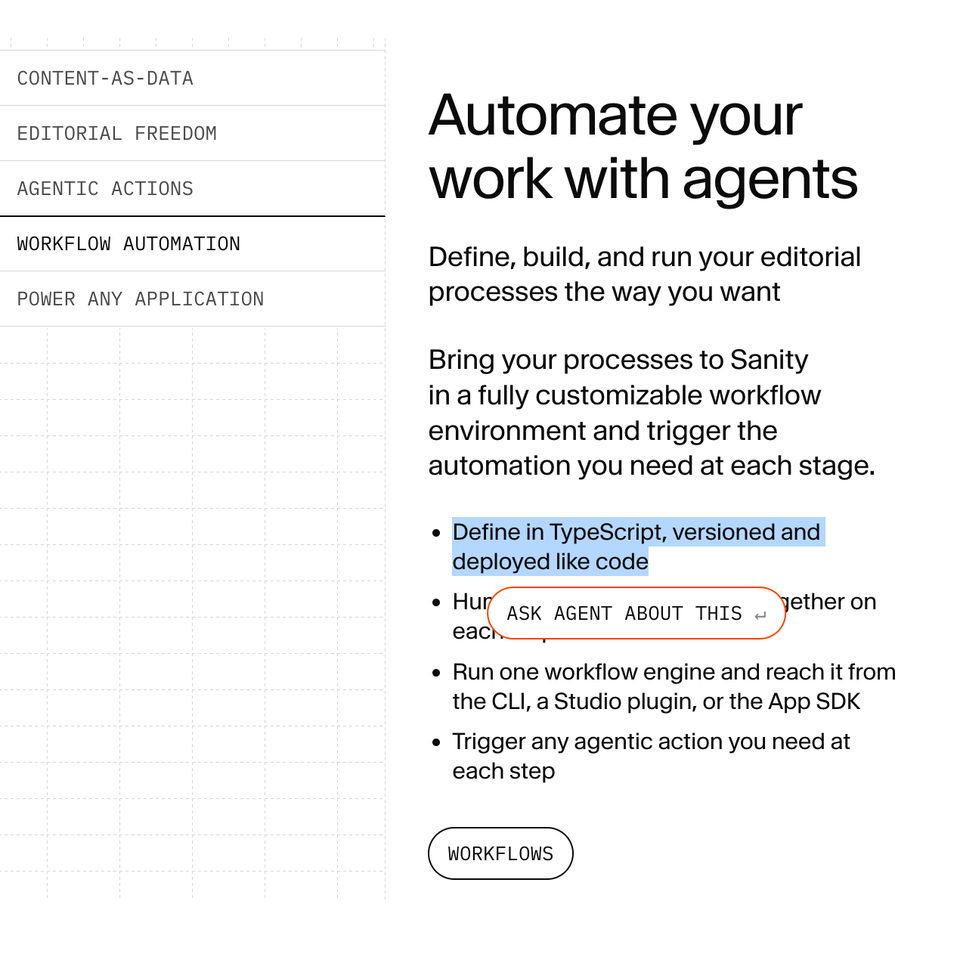
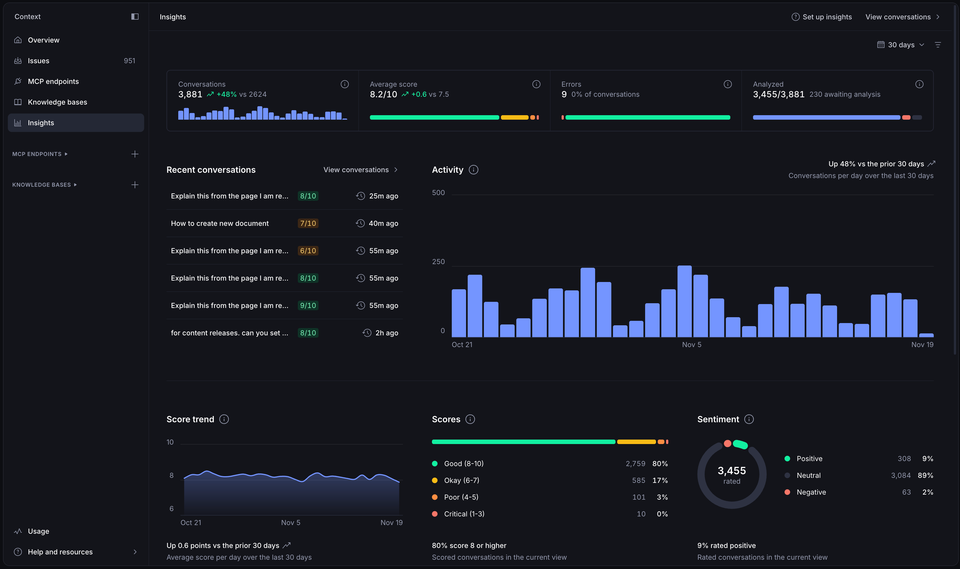
The first is knowing whether it works at all. On our own site, you can highlight any copy and ask our agent to explain or elaborate on it. A user who did this on our homepage got an answer about a different feature than they highlighted, and people opened it 55 times before we noticed (and fixed it). You should be able to read real conversations, see which answers had no good source, and find the gaps yourself, without waiting for a developer to pull the logs. If your agent doesn't work, it's a liability, and the people who own the content should be the first to know.
The second is accountability. The same e-commerce leader told us: "Approvals all come from somewhere else. They do not exist in the system." To prove a policy was approved, the team has to "go dig it up in a Slack channel or an email or a Word doc." A fintech company told us their auditors asked "what was your SOP in December?" If you're regulated, or just want to learn over time, you need to know which version of which fact the agent used, who approved it, and when it expires. You can't vibe your way through an audit.
Content is context
Most of what I heard over these months wasn't about specific retrieval techniques or which model to pick. It was about who decided, where that decision lives, and whether anyone notices when it changes. Content teams have answered those questions for websites for years. Now an agent repeats the answers to every customer who asks.
Content is context. It always was.
That's why we built Knowledge Bases. You point one at the sources you already have, like your help center, your website, or a set of files, and it compiles them into structured entries any agent can use over MCP. Once it's built, you can:
- see what changed in your websites and datasets before your agent does
- pick the right answer when two sources disagree, like a help center that says 30 days and a product page that says 45, and have that decision carry into every future build
- trace every answer back to where its facts came from, and see in Insights which questions had no good source
Knowledge Bases is but one part of Sanity Context. The rest is where teams and agents create, review, and publish the content that becomes canon.
Our customer Braze is already working this way. Matt Chamberlain, who leads applied AI product there, said it on stage at our Everything NYC event: "The knowledge our teams rely on to sell, support, and compete keeps the business running, but most of it goes stale because nobody has time to maintain it." Braze built a competitive intelligence knowledge base on Sanity that its go-to-market team can read and edit, with an agent that reads sales call transcripts and updates the intel where it finds gaps.
The first agents learned about the world from the open web. The ones you put in front of your customers have to learn your business from you.
What to do on Monday
So what is the standing with your canonical context? You need an afternoon and 20 questions your customers are likely to ask, and do this quick audit:
- Run the closed-book test. Write 20 questions a customer might ask about your business: prices, plans, policies, what you do and don't promise. Ask your agent, in Claude or your customer-facing chatbot. Every confident wrong answer is something you should fix in the canon layer.
- Find the copies. For each of those facts, list every place it lives. I'd be surprised if your company didn't disagree with itself somewhere.
- Build a Knowledge Base from those sources. You can build one for free from your help center, your website, or a set of files. You don't need any content in Sanity to start, and it will show you where your copies disagree.
- Give every fact an owner. Decide who approves it, where that approval lives, and when it gets reviewed again. If nobody owns it, it's already drifting.
- Connect your agent and run the test again. Ask the same 20 questions and count how many it still gets confidently wrong.
Then tell me how it went. How many of the 20 did your agent get confidently wrong, and which one surprised you? Reply here or send me a DM. I read all of them, and would love to get more perspectives and experiences.